




Table of content
How Creative Takes Precedence Over Audience Data for Driving Overall Campaign Performance (Which Is Notable Coming From The Former CEO of BlueKai and the Oracle Data Cloud).
For seventeen years, the digital advertising industry has treated audience targeting as the lever that mattered most. Build the right segment, serve your creative wherever you could find the audience, and performance would follow. Entire categories of ad tech, including some of the infrastructure we helped build at BlueKai and Oracle, were engineered around that belief.
Audience data is important, but what if we had part of this backward? What if, instead of starting with a hypothesized audience and serving all creatives to that fixed audience, we started with the creative and used it to determine who to serve to? In this formulation, the creative itself is an incredibly rich source of data that drives the targeting and our understanding of the audience. By "creative" we don't mean a single finished ad. We mean the bundle of choices that make it up: visual format, hook structure, tone, and subject matter. Each of those choices has a relationship with who has engaged with similar creatives before, and that is what influences who a given creative should be shown to now.
In what follows, we will show that the above hypothesis isn’t novel and is already driving a tremendous amount of campaign strategy at TikTok and Meta. What is novel is the ability to make this work at scale across the open web and CTV beyond the walled gardens. But first, we will show how this works in social before expanding the thesis.
Audience Targeting was always only a piece of the puzzle
Audience targeting asks "who is my buyer?" and tries to answer that question before a single impression runs. It's a hypothesis, tested in a slow expensive manner: define the segment, buy the media, wait for conversion, and then find out if the guess was right.
In 2017, Nielsen analyzed nearly 500 advertising campaigns to determine what truly drove sales lift. The result: creative quality accounted for 47% of total sales impact (more than any other factor), while targeting, the thing the industry had spent the prior decade building entire data businesses around, accounted for just 9%.
A later NCSolutions study, using a similar methodology across roughly 450 campaigns, found the pattern hadn't moved. Creative still drove about 49% of sales lift. Targeting had crept up slightly, to 11%. When Nielsen isolated digital campaigns specifically, the channels most associated with precision targeting, creative's contribution to sales lift rose to 56%, while media and targeting combined accounted for only 30%.
This is important. In the channels built specifically to make targeting more precise, targeting mattered less, not more, relative to creative.
The platforms that caught up to the insight on creative
Meta's 2026 Andromeda update replaced Meta's decade-old, audience-first ad retrieval system with one that reads the creative first: visual format, hook structure, tone, subject matter. It predicts who is likely to engage based on behavioral signals, and serves the ad accordingly. Advertiser-defined audiences such as interests, demographics, lookalikes are now treated as soft suggestions the system can override, not hard gates it has to obey. Meta's engineering team has described the retrieval-stage rebuild as introducing something on the order of a 10,000x increase in model complexity over the system it replaced.
The practical fallout has been visible across the industry for months. Lookalike audiences, once a default targeting strategy, have stopped outperforming broad targeting paired with strong creative, because the platform's behavioral signal now exceeds anything a seed audience was ever able to define. Constraining Andromeda with a lookalike doesn't add precision anymore. It adds friction to a system that's already better at finding your buyer than your audience definition is.
The results of this transformation are showing, According to Edwin Choi from JetFuel “Brands testing 20+ new ads per month are seeing 65% higher ROAS than those testing fewer than 10.”
To call out the obvious, these are Meta's own reported figures, from Meta's own environment, and should be read as directional rather than guaranteed for any specific account. That being said, Andromeda isn't a strange new bet. It's a mechanical expression of what Nielsen's data said all along.
TikTok demonstrates that creative volume, creative diversity and iteration are all elements of success.
Just as Andromeda benefits from more than 20 creatives per month, TikTok also recommends running 3–5 creatives per ad group and adding 3–5 fresh creatives about every seven days as fatigue emerges. Effectively that means 12–20 new creatives per ad group per month. TikTok calls creative-refresh frequency the leading factor determining an ad group’s lifespan. Given the need for high volumes of creatives and the difficulty of delivering them, vendors have emerged to fill the vacuum.
Parallel Distribution is an example of one such company that leans into TikTok’s creative requirements to help marketers test and produce more creatives (full disclosure, Superset where I am a GP is an investor in them). Parallel Distribution, which produces 5,000+ creative assets each day which help power dozens of the top TikTok Shops, frames this as an exploration-versus-exploitation problem. Frontier models help humans and agents distinguish between the exploration of net-new ideas and the exploitation of proven ones, then allocate production between the two to maximize GMV. The limiting factor is rarely the ability to render one more variant. It is the ability to introduce enough high-quality creative inputs to increase volume without repeatedly recycling the same ideas. Purely AI-driven ideation tends to converge because of what’s known as “model collapse”, which makes continuous human and cultural input necessary for sustained creative diversity.
To make the point about creative diversity, Parallel Distribution produced the chart below based on data exported from Kalodata.com. The chart shows the number of creatives running each day for the top 500 tiktok shop brands. In the chart; "Video and Ad Items" = Total amount of creative delivery during the selected period and "New Videos by Affiliate" = newly created creatives during the period. As you can see there is a high correlation between creative volume and GMV based on raw dollars and raw creative volume (correlation of r ≈ 0.74–0.78). Even when you compare them in log space, the way you'd compare quantities spanning three orders of magnitude the creative volume explains up to 25% of the variance in GMV.
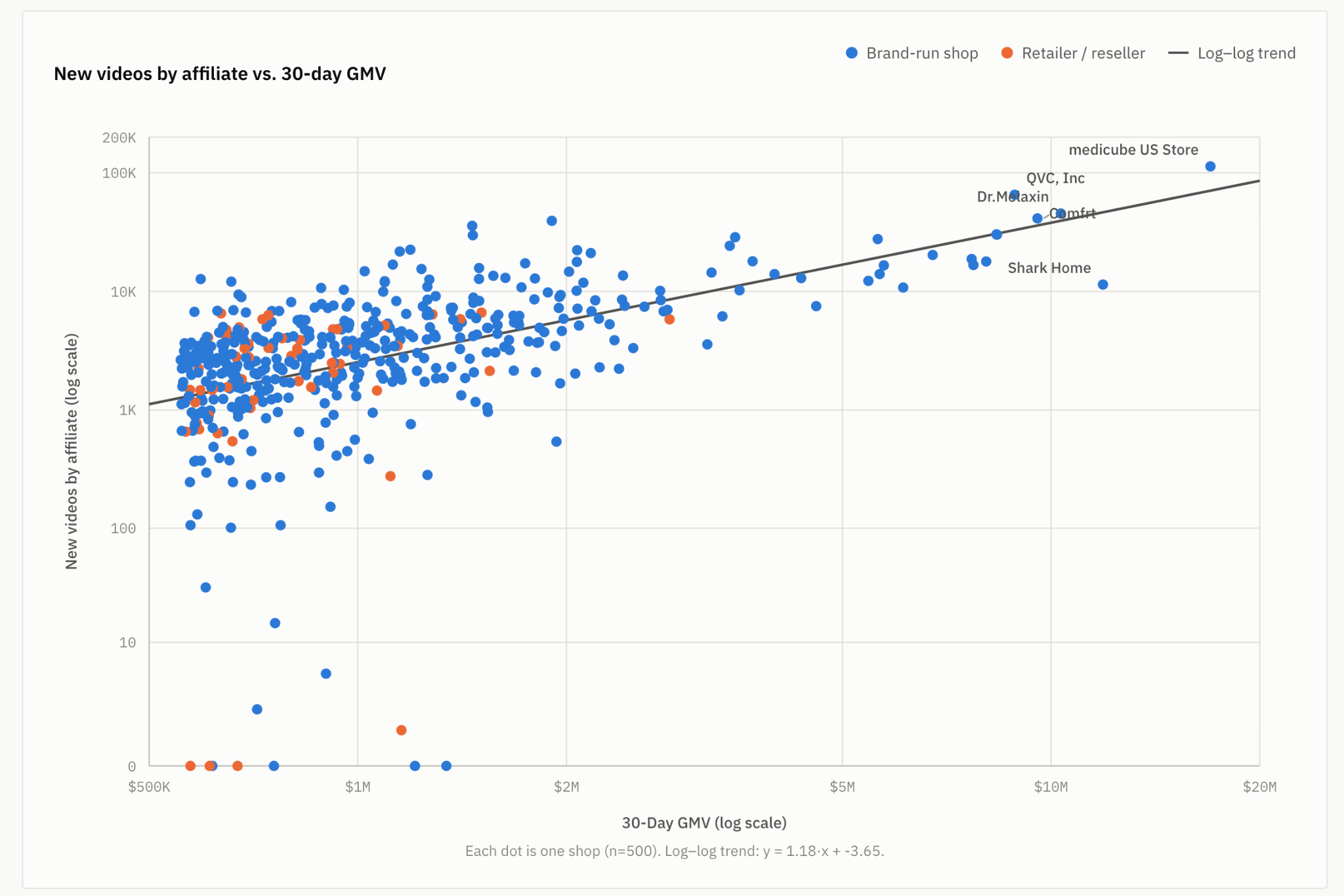
Given what we saw above, the volume of creative alone is important, however, it is not the objective. The relationship between creative volume and sales depends on what that volume contains. Hundreds of minor edits to the same underlying concept may increase the asset count without materially increasing the number of ideas being tested. Advertisers need both creative diversity and creative iteration. Diversity introduces new formats, messages, and concepts; iteration develops variants of ideas that have already demonstrated promise. The two serve different purposes, and an effective creative system needs both.
This is why acquiring high-quality creative at scale is more difficult than simply increasing production capacity. Entire categories of UGC agencies and AI creative companies have emerged to create reliable sources of new creative input. The important measure is not the raw number of assets produced, but the cost of acquiring genuinely new ideas and turning the strongest of them into enough intelligent iterations to identify winners. Below, we discuss an alternate approach to this problem utilizing Spaceback’s social creative as the seed for the ad creative.
An industry reframe: a creative to activate every audience
The big strategic shift here is in what drives risk. Every audience segment worth reaching already exists inside the platform's data, whether or not you target it. What determines whether you reach them isn't your targeting settings. It's whether one of your creatives is the kind of message that earns their attention.
So what?
The real risk isn't picking the wrong audience anymore. It's creative underexposure: having a segment worth reaching, and nothing in your creative library built to earn their attention, so the algorithm never had a reason to route anything their way. Underinvesting in creative doesn't just limit your reach with the audience you already had in mind. It forfeits demand from audiences you never knew existed, because you never gave the system a message capable of finding them.
A change in how you allocate budget
None of this is free. Creative targeting doesn't eliminate cost; it shifts it from targeting infrastructure to creative production, creative diagnostics, and initial media testing. Meta's own benchmarks make the volume requirement explicit: brands running 20 or more new ad concepts a month see roughly 65% higher ROAS than brands testing fewer than 10. Large-scale creative testing data suggests only about 6 to 7 out of every 100 variants turn out to be genuine winners, which means volume isn't optional, it's how you find the messages that work at all.
Recent EMARKETER and Perion research found that 89.2% of marketers already believe creative is important to campaign performance, but only 3.6% say their creative performance is well understood and actively optimized today. The industry has already accepted the thesis. It just doesn't have the infrastructure to act on it. Most teams are still finding out how a creative performed weeks after it ran, if they find out at all. Over 40% of marketers report getting creative insights two to four weeks post-launch, and some report getting none until the campaign has already ended.
Why is this even possible and why now?
The social landscape has shifted toward what might be called a ‘content meritocracy’. Platforms learned that the most effective mechanism to retain attention was to loosen the relationship between whom a user follows and what that user sees. A follow is now one signal among many. Engagement, watch time, and the probability of continued viewing increasingly determine what appears next. TikTok’s meteoric rise was powered by this content delivery model, and every major social platform has spent years adapting to it. Even LinkedIn has caught up and is starting to surface short form videos not constrained to your actual network.
Advertising has to operate inside the same evolving environment. When an ad appears in an Instagram feed, the platform needs that ad to retain attention nearly as well as the organic content around it. Andromeda is optimized around the same set of principles. A marketer may optimize for attention or for a downstream action, but in either case the system uses the creative and the observed response to discover who should see the ad.
This is why ad delivery increasingly resembles organic discovery, and why systems such as Andromeda begin with the creative itself.
Think of creative targeting as if you had access to a time-series topology of your consumer’s attention. With such a powerful, constantly updated map, we can finally produce the creative that will break through to their attention at every moment. That is why creative targeting is possible now and not, say, two or three years ago. Doing this type of topological attention map is extremely important now because otherwise consumers are doing everything in their power to skip interruptions that don’t meet the moment. To quote Gartner from their most recent marketing survey: “When 81% of consumers are trying to tune out ads, the cost of interruption is higher than ever. Brands need to prioritize ad experiences that feel respectful, relevant, and creative.”
Beyond the Walled Gardens
This is all great for the walled gardens where the algorithms have access to all the underlying data without forcing the brand to explicitly pay for the data, and the walled gardens also have a relatively cheap and fast way to conduct creative testing. What about the open web and CTV? Two conditions have changed that now make this strategy practical beyond the walled gardens. Without these two fundamental advancements, this strategy would not be ready for the Open internet and CTV.
The first change comes from Social Intelligence and Creative tools like Rembrand’s Spaceback. Andromeda asks for 20 or more new ad creatives a month that they will later put into rotation and test. Until now, it has been expensive to produce and approve so many different creatives to test for a brand. And if you produce them, it is expensive to run these creative tests outside Meta. What is new is that Spaceback Social intelligence can find social creatives including creator posts, paid social, and posts from the marketer’s own handles, that have proven performance and then convert them into ads for CTV and the open internet. Think of this as engaging the topological attention map described above to select a smaller number of tested creatives that don’t force you to generate from scratch. Where Andromeda might ask for 20 creatives to start testing with, using social creative intelligence from Spaceback with its DCO features, we can reduce that requirement to less than 5 creatives, with DCO creating multiple small variants that will appeal to different audiences. You don’t have to waste as much media budget testing if you are able to leverage the organic posts first that serve as already tested creatives for an audience. It doesn’t completely eliminate the testing, but it does reduce the creative variance needed by a wide margin.
The second change is in how data is selected and paid for in targeting for a campaign in the open web. As an example, I will use theTradeDesk (full disclosure, I am on the TTD board and have an obvious bias for them). TTD recently released Audience Unlimited. In theTrade Desk’s own words, Audience Unlimited makes third-party audience data cheaper, simpler, and more effective by replacing costly à-la-carte segment fees, often approaching 20% of media spend, with broad access at a predictable 3.3% or 4.4% fee in Control Mode or no additional cost in Performance Mode. Advertisers provide a seed audience, ideally purchasers or converters, and TTD’s AI scores, tests, combines, and continuously optimizes thousands of eligible data segments based on their relevance and performance. This lets advertisers discover the right data signals for a creative without developing an expensive hypothesis in advance. This capability may not have been explicitly built to enable creative targeting, but it makes it easier for an advertiser to discover the target for a creative without having to rely on a fixed audience hypothesis.
Taken together, these advancements allow you to expand Creative Targeting beyond Andromeda and into the open web. You can take the best of what's already been invested in creative production for social (based on extensive performance signals) and convert it to the open web and TV without duplicating efforts or creating all these variants for CTV. You then use solutions like theTradeDesk’s Audience Unlimited to tweak the audience that sees each creative using conversion signals without having to pay upfront for an audience hypothesis. Instead, the system will discover the right answer for a reasonable cost.
Where this leaves advertisers
The instinct to control performance by controlling audience definitions made sense when targeting was the most precise instrument available. It isn't anymore. The platforms have rebuilt themselves around creative as the primary signal, and the underlying research, some of it over a decade old, suggests they were right to do so.
What advertisers need now isn't a better audience strategy. It's the ability to produce creative at real volume, and the intelligence to know which of it is actually working, before the algorithm has to guess on their behalf. That's a production problem and a diagnostic problem, not a targeting problem, and it's where the next round of competitive advantage in performance marketing is going to be won.
*Sources: Nielsen, "When It Comes to Advertising Effectiveness, What Is Key?" (2017); NCSolutions creative effectiveness meta-analysis; Meta engineering communications on Project Andromeda; EMARKETER/Perion creative optimization research (2026); EMARKETER/TripleLift creative effectiveness report (2026); Statista U.S. digital video consumption estimates.*
.svg)


