




Table of content
This week, Omnicom Media and Rembrand announced a first-to-market capability that lets brands identify, plan, and activate in-content placements across premium streaming inventory (Digiday, October 7, 2026). It runs on VISTA, our AI system that scans publisher content and finds scenes where a brand can belong. It then uses our AI Studio to render, insert and deliver the scenes.
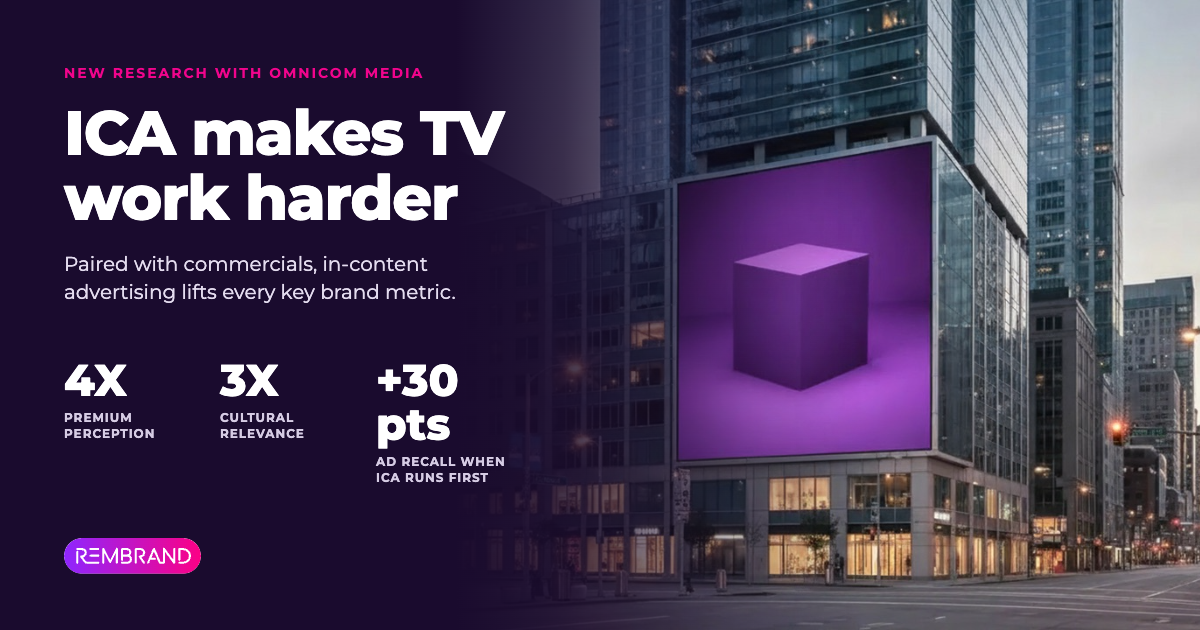
Omnicom Media called it the first time this capability has been used by the buy side, after years as a sell-side tool. That shift is important because it puts in-content advertising (ICA) directly into the Omnicom operating workflow, and as a result, ICA stops being a special area of innovation and starts being a line in the plan that any brand can take advantage of. The partnership follows a controlled study we ran with Omnicom Media's Partner Intelligence team, resulting in a research called Beyond Interruption. The data is clear: ICA works, and it makes TV commercials work better.
What: ICA is growing fast, in the US and around the world
In-content advertising places brands directly inside the shows people choose to watch: virtual signage in an outdoor scene, a branded screen in an office, a product on the kitchen counter. AI does the work after the show is produced, so placements that once took months of negotiation can now be planned and activated at scale.
The demand behind that growth is simple. Viewers have learned to tune out the break. In the Omnicom Media study, 65% of consumers said they avoid ads to some degree by skipping, muting, using ad blockers, or paying for ad-free tiers. At the same time, 85% said brands should experiment with new ways to connect with them, and 77% agreed the brands that break through are the ones that show up in innovative ways.
In the US, Omnicom Media is now building ICA into its buying workflow, matching audience data with streamer viewership to pick the right shows and mapping them against in-content opportunities in VISTA. Outside the US, the category is moving even faster, with publishers and agencies across Asia, South Africa, and the Middle East adopting ICA as a way to add brand revenue without adding ad load and capture attention that can't be ignored.
Why: ICA makes all TV advertising perform better
The study tested ICA and traditional :30 video ads in a controlled experiment with 1,559 US adults who watch ad-supported streaming weekly. Viewers were randomly assigned to control or exposed groups, and brand metrics were compared between them across consumer packaged goods and consumer tech brands.
The headline finding: ICA is a multiplier. When ICA ran alongside traditional video ads, every key brand metric moved further than with video alone.

ICA reaches the people who skip the break
Among viewers who actively avoid ads, ICA lifted the share who said a brand "grabs my attention" by 9 points. These are the viewers a commercial pod struggles to reach at all. ICA reaches them inside the content, the moment they are paying the most attention. Viewers noticed the difference. In open-ended responses, they described ICA as natural, part of the show, and not pushy. Younger audiences lean in hardest: Gen Z indexed at 129 for preferring brands integrated naturally into the show, and Millennials at 110.
Attention is highest inside the show
The strongest results came where engagement was highest. Among viewers who said the show held their attention throughout, ICA tripled the lift in cultural relevance. When brands become part of the show, they become part of the culture around it.
How: getting the most from ICA, and where the category goes next
The study also showed how to plan ICA for maximum impact. Two levers stand out.
Lever 1: content quality. The stronger the show, the harder ICA works. Among viewers who rated the show high quality, ICA plus video lifted purchase intent by 14 points, premium perception by 10 and message retention by 11. Among viewers with a moderate view of the show, those lifts were 3, 0 and 2 points.
Lever 2: sequencing. Order matters. When viewers saw the ICA first and the commercial second, unaided ad recall rose 30 points versus 22 when the order was reversed, brand familiarity rose 11 versus 7, and favorability rose 13 versus 7. ICA primes the viewer; the commercial lands the message. Leading with ICA delivered nearly 2X the gain in favorability.
Three years of building a category
These results validate the work we have been doing for the last three years. We set out to make in-content advertising automatic, photorealistic and easy to buy, measure and scale. That meant building the technology, assembling a network of premium content partners, and proving the results with independent research. It also meant making ICA a real format. ICA is now standardized with the IAB, which gives buyers, sellers, and measurement partners a common definition to plan, transact, and report against. Standardization is what turns a novelty into a media line item.
What comes next
The Omnicom Media partnership is the next step: ICA planned with audience data, matched to premium streaming content, and bought alongside the commercial in one workflow. Cox Automotive has already raised its hand to learn more. From here, our focus is scale, consistency, and measurement, so every brand can plan ICA as part of the modern TV toolbox.
The bottom line
The commercial is not going away, and it should not. The data shows that the commercial works better when the brand is also inside the show. ICA reaches viewers who skip the break, primes them before the spot, and lifts premium perception, relevance, and intent across the whole campaign. That is why a holding-company media network is building it into how its clients buy. That's why we think in-content advertising will be a standard part of every TV plan heading into 2027.
Read the full study: Beyond Interruption: How In-Content Advertising Builds Brands
Read the announcement: Omnicom Media and Rembrand partner to evolve in-content ad placements (Digiday)
Methodology: Controlled experiment by Omnicom Media Intelligence and Rembrand, 2026. US adults 18+ who watch ad-supported streaming TV at least weekly, N=1,559. Results are exposed minus control deltas; reported lifts are significant at 90% confidence or higher unless noted.
.svg)


